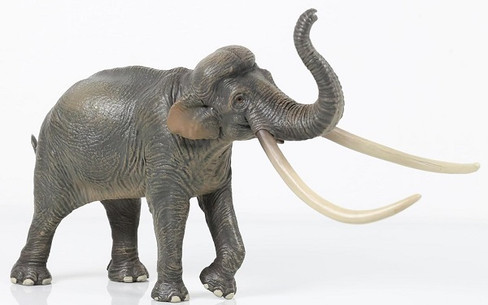
Haolonggood Palaeoloxodon - B recreates the enormous straight-tusked elephant as a 1:35 collector-scale model, with massive proportions, sweeping tusks, a raised trunk, and extensive skin texture that emphasize the imposing form of this Pleistocene proboscidean. This is the Brown Version.
Also, you can shop the gray version: Palaeoloxodon - A (Haolonggood)
The Haolonggood Palaeoloxodon - B measures: 9.5" L x 2" W x 5" H
Model Scale: 1:35
Haolonggood Palaeoloxodon - B Product Review
The Haolonggood Palaeoloxodon - B presents the straight-tusked elephant in an active walking pose, with one foreleg advancing and the trunk lifted forward. The large head flows into a thick neck and high shoulders, while the deep torso and substantial limbs convey the mass expected of a giant prehistoric elephant. Long tusks project forward from the skull before sweeping outward and upward, giving the model a distinctive profile. Wrinkles and folds extend across the trunk, face, ears, neck, body, and legs, with finer surface texture breaking up the larger areas of skin. The eyes, mouth, toenails, and folds surrounding the joints provide additional anatomical definition.
The balanced stance allows the model to display well from multiple angles, while the raised trunk and forward movement give it more visual activity than a static standing pose. Its proportions and anatomical details make it useful for collectors building displays of Pleistocene mammals as well as for families and educational collections comparing extinct proboscideans with modern elephants and mammoths. The combination of large tusks, substantial body mass, elephantine anatomy, and textured skin provides recognizable features for examining how Palaeoloxodon differed from other prehistoric elephants.
Palaeoloxodons Information
Palaeoloxodon antiquus, commonly called the straight-tusked elephant, was one of the largest land mammals of Pleistocene Europe. It became widespread in Europe roughly one million years ago and was especially associated with warmer interglacial environments. Fossils have been found across much of Europe and into western Eurasia. Unlike the cold-adapted woolly mammoth, Palaeoloxodon antiquus was strongly associated with temperate landscapes that included woodland and mixed open habitats.
This enormous proboscidean had a high skull, massive body, column-like limbs, and exceptionally long tusks that were generally straighter than those of mammoths. It was primarily herbivorous and consumed vegetation available in productive temperate environments. Its great size would have allowed adults to reach vegetation at different heights while also making healthy mature individuals formidable animals. Like living elephants, Palaeoloxodon probably had an important ecological influence through feeding, trampling, and movement through vegetation.
Palaeoloxodon fossils are known from numerous European Pleistocene sites. Neumark-Nord in Germany is especially significant, with more than 1,500 skeletal remains representing approximately 70 straight-tusked elephants. Archaeological evidence from the site has also contributed to research into interactions between Neanderthals and these enormous animals. Palaeoloxodon remains therefore provide information not only about elephant evolution and Pleistocene environments, but also about the relationships between prehistoric humans and some of the largest terrestrial mammals they encountered.
Part of the Prehistoric Animals Collection by Haolonggood
Part of our collection of Dinosaur Figures
Made of durable synthetic material by Haolonggood. Hand Painted.
Product Code: HLG-002-B
Model Number: Haolonggood #002-B
Brand: Haolonggood